Browsing Posts in Project Communications

I have always thought that summer was a time for “renewal.”

After all, isn’t that why there was no school in the summer, and why your parents sent you to those summer camp “enrichment” programs?  It was so you could relax and enjoy some subjects and activities that you were not exposed to during the remainder of the year.  And as you got older, perhaps you had a chance to attend a special summer program in a college or university setting, where other students like yourself could engage in debates and cultural activities that were “enriching.”

At some point in your life, you may have noticed that there was a transition away from those “renewal” activities that were planned by others, to renewal activities that you planned by yourself.  Maybe you didn’t notice this transition since you were caught up in the fast pace of growing up, but, as John C. Maxwell has said, “man has choices and the choices a man makes in turn make him.”

So–Summer is a time for renewal.  It’s up to you to grasp those opportunities for renewal wherever they might be in your life.

And, if you are part of a larger project community, or a member of a Program Management Office (PMO), it might be time for you to seek out some activities to renew your PMO as well.

What better time than the summer to pursue such renewal?

Give this some thought.  How can I as a project or PMO practitioner provide some renewal activities for my PMO?

Show some leadership and initiative to make this renewal something that lasts year-round in your PMO.

For example, look at some liason opportunities with a local PMI Chapter, or some special training that could be brought on-site to enrich your colleagues in the Best Practices of a PMO.

Renewal is up to you.  No one will plan for it any longer.  Summer is a great time to pursue it.  Get started today.

Ultimately, after all is said and done, I believe that we all are searching for “happiness” in our lives.  It’s that combination of emotions, activities and long lasting collaborations which bring us satisfaction and enjoyment from living everyday.

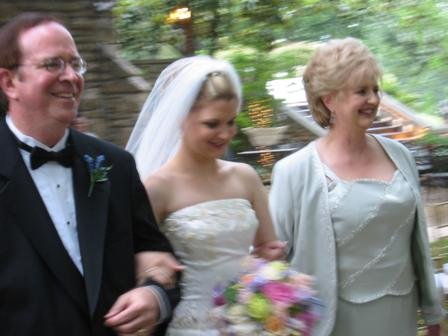
When my daughter was married six years ago, I gave a toast in which I addressed “happiness.”  I said that happiness really consisted of three different things. 

First, if you think back to the past to those things that you have shared with your loved ones, which have made you feel good and fulfilled, that was a first step to happiness. 

Second, if you think about the present day and those events and emotions you share with your loved ones which bring you special joy in the present moment, that is a second ingredient to happiness. 

Third, and most importantly, if you think about the “anticipation” of those things you will share with your loved ones in the future, and how you can work to enrich those experiences for each other, then that is the ultimate ingredient for happiness.  

Lou Tice has often said that “People move toward and become like that which they think about.” 

Thinking about and anticipating happy experiences in the future will help to bring them about and make them an integral part of your life.

My toast was very sincere and heartfelt.  I wanted to leave a lasting impression for my daughter and her husband to be to contemplate as they approached the future together.

Much the same thing can be said about project managers.  I believe that each project manager is seeking “happiness” in his or her own context of the project and the project community.  To really achieve “happiness,” a project manager must look back, examine the present, and anticipate the future.

As a project manager, where are you seeking happiness in your projects?   Perhaps you never thought about a project or a project team being a source of happiness.  But, if you believe my initial premise that all of us are ultimately seeking happiness in our everyday lives, then a project manager must really address his entire experience in–and out of–projects.

Feedback?

I have noticed recently, in the Discussion sections of  LinkedIn’s Project Managers, PMO, and PMO Bloggers Groups, that aspiring young project managers have been requesting advice from more experienced project managers and PMO leaders as to what steps they can take to enhance their ability to move forward in the “project community” and to advance their project management skills. 

From my point of view, having worked in several PMOs and IT Project Offices, as well as having assisted in the setup of several PMOs, I would like to offer the following advice, which follows from something I read by Jillian Michaels, the very successful coach of the hit TV show “The Biggest Loser“.

Jillian once said that individuals and organizations can accomplish anything they want to accomplish as long as they are sufficiently motivated and have the “capability” to succeed. 

My advice is focused on the aspect of “capability” because there is much that aspiring project managers can do to enhance their “capability.”  Capability means educating oneself and understanding the business context within which they are operating.

By aspiring young project managers, I actually mean project team members who are qualified to move up to managing projects but who haven’t found that right project to manage yet OR project managers who have just assumed a new project management assignment for which they must prepare themselves to fully succeed.

Here are five areas in which aspiring young project managers can enhance their “capabilities.”  These five areas will leverage your understanding of the project process, as well as increase your stature among other project managers in the “project community.”

First, volunteer to record the minutes at an important project status meeting.  Be sure to find or create a template that captures the participants, the date and time of the meeting, the agenda, the actions agreed to, the assignments for each participant as well as any completion dates, any issues that were not resolved, and the date and time of the next meeting.  Too many project teams lapse into keeping very poor documentation of their meetings and therefore, accountability for completing assignments is lost.  By volunteering for this assignment, you will provide a key document to the project team from which they can build on throughout the project.

Second, at the conclusion and documentation of the project requirements, survey the sponsor and the stakeholders to understand that they really know what requirements they have signed up for and the “commitment” that is required to carry out the project.  By doing so, you will have input into any “Scope Change” that may arise ahead of the actual requirements modification.  This will increase your understanding of the project process and your stature among other project managers.

Third, at the conclusion of the first major phase of the project, insist that the project team hold a “lessons learned” session.  They will thank you later even though you may have to drag them to the table kicking and screaming to participate in the first session.  So many things get uncovered when you “shine a little light on something” or “focus” on the actions and results at this point.  Famed UCLA basketball coach John Wooden once said “It is what you learn after you know it all that counts.”  This has terrific application in project lessons learned.

Fourth, find a key “issue” that seems to divide the project team members or the stakeholders and follow that issue by recording key actions and decisions made by the team and the stakeholders.  At an appropriate point in the project, when it appears that the project team or the stakeholders or both have reached an impasse or a stumbling point, pull out your summary of the actions and decisions and review it with the combined project group.  Some may not appreciate being confronted with the facts, others may disagree with your “facts” or your interpretation–but no one can disagree with the harmony that will result down the road when they begin to see each others different perspectives and viewpoints, and the fact that a “rational, realistic” observer brought these viewpoints to their attention.  You may have won yourself a job!!!!

Your facilitation of a bumpy issue by offering extraordinary insight and “analysis” is the key.  “Analysis is the essence.”

Fifth, practice the four communications mechanisms that I discussed in one of my previous blogs:

1.  Situational

2.  Metaphorical

3.  Empathic

4.  Resonance

I use the word “practice” here because it will take the aspiring new project manager some time to understand the situations in which these four communications mechanisms will be most effective.  But they all have a place at some point in a project.  By using these communication tools, your “effectiveness” as a project communicator will be enhanced many fold.

By the way, you won’t find this advice anywhere else–it is unique to taking a “holistic” view as to what a project is all about and to understanding how stakeholders impact projects. 

Good luck to you “aspiring project leaders.”  Yes, you are and will be leaders if you follow this advice.

The Best in all that you pursue…….

I genuinely want to share my experiences developing several Program Management Offices (PMO) and an IT Project Office with others who may be facing the same issues and similar situations.  I believe that I have valuable insights about the behavior of project teams, project managers, stakeholders and project organizations that are worthy of sharing with others.   The comments that I have received on my posts from the “project community” have supported my belief.

What do I mean by the word “community” and the phrase “project community”? 

In my mind, a “community” is a loosely connected group of people who have common interests in a field or discipline.  They are all interested in the growth and well-being of that field or discipline. 

A “community” need not be all in the same organization or in the same geographical area.  It does, however, need some framework for sharing information and collaboration.  Such a framework allows the community to benefit from the work of its members, from the input of outsiders whose ideas impinge on the community environment, from academics, and other researchers. 

Social Media and Social Technology facilitate such a community environment.

Rich Maltzman, who writes “Scope Crepe“, first alerted me to the importance of a “project community.”   We were talking about the evolution of PMOs–from strictly IT PMOs, or Shared Services PMOs with a particular “mindset,” to Enterprise PMOs (EPMO), and to PMOs designed to serve specific targeted project goals and objectives or requirements (such as Smart Grid with some utilities). 

Rich said that regardless of how many PMOs there were in an organization, it was important to maintain a sense of “project community” across the PMOs.  “Communities” contribute to the well being and ongoing growth of the members of the community.

In her book Open Leadership, Charlene Li presents an excellent model of “engagement” that could apply to either an organization or an individual engaging a community.  The hierarchy of increasing engagement proceeds as follows:

1.  Watching

2.  Sharing

3.  Commenting

4.  Producing

5.  Curating

The evolution of this blog has followed this model. 

First, I watched as the “project community” embraced the PMBOK, and the literature surrounding the progress of projects in a corporation from early simple executions to large scale executions of tremendous strategic importance to the corporation.  At this point, the PMI and its chapters engaged with the “project community” via publications, on-line web sites, and periodic meetings throughout the world. 

As I progressed through the stages of Sharing and Commenting, I was reacting to the written and spoken words of others in the “project community” who were contributing to the processes, standards, and methods by which good Project Management Practice was being spread throughout the community. 

Now with the stage of Producing, I am contributing to the literature and culture of the “project community” with my own unique observations, analysis and insights.  

I feel that the Curating stage lies ahead because I am still a “youngster” when it comes to “contributing.”  Social mediums, such as blogging, have certainly furthered this journey–and, yes, it is a “journey” of growth and awakening and finding out how much I don’t know about things I should know.

I also write this blog because it has restored some sense of “identity” to me.  When my manager at Exterran Corporation informed me in October 2009 that my company position or job had been eliminated in a budget cut, that my services were no longer required, and that I should clean out my desk and leave the building, I was amazed by my own loss of “identity.”  Like many other people, I largely associated myself, my work life, and my accomplishments with a “Corporation.” 

If you have seen the movie “Up in the Air“, this experience was very much like sitting across the desk from George Clooney and listening to him say, in his monotone voice:

“You are being terminated from the Company and I will need your access badge.  Please be prepared to leave the building as soon as possible with your personal belongings in this box.  And don’t worry.  All  your questions will be answered if you read what’s in this small packet.”

Authoring this blog has renewed my sense that I have something worth saying, something worth contributing, something worth reading and assimilating into the day-to-day “project environment” that the “project community” lives every day. 

The “Journey” has not been without its setbacks though.

Recently I sat across the desk from a manager at a major energy company who said to me  ”You know what your problem is?  You have no ‘brand.’  You come to me with no ‘brand’ that you can identify yourself with.  That means you are really unknown.” 

How untrue.  My brand–and my mission–is to give the “Project Community” the substance that it needs when it most needs it.

The head of a major executive search firm recently said to me “You know what your problem is?  You are like so many other people out there right now with too much time on your hands.   So you write this junk and think others will care about it.” 

The project community does care about these issues.  The proof lies in the comments to this blog and the constant positive feedback that I have received.

What I have to say is directly related to events in our world today.  The BP crisis in the Gulf points to the fact that we really have not learned our lessons from previous mishaps.  Someone needs to keep reminding us.

The Social Media revolution is an event that we cannot deny.  People are relying on other people–through social media–to satisfy their wants and needs; needs they once satisfied by going to established stores, banks, or other institutions.   Charlene Li referred to this phenomenon as a “groundswell“–a social trend whereby people use technologies to get the things they need from each other, rather than from traditional institutions such as corporations.

So, why do I write this blog?  To “connect” to the “project community” and hopefully, to give that community back as much as it has given me over the past twenty or thirty years. 

If everyone were to approach their interactions in a similar manner, they could find the “self direction,” “mastery,” and “Purpose” that Daniel Pink writes about in Drive.

I urge you to consider how you can contribute and give to the “project community.”  What skills, experience, ideas, innovations and specifics can you contribute to everyone who wants to grow and nurture the project discipline in the same manner?  What project lessons can you share with another project manager who is facing a similar situation or scenario?  What project analysis did you perform which led to successful completion of some very difficult phase of a project that you could share with your “project community?”

If you are watching, sharing and commenting to the work of others in some fashion, I urge you to consider “Contributing” through your writing, observations and insights about projects and programs.  Your reward in returns of new information, insights and knowledge will be amazing.

As usual, your comments are welcome.  Thank you for your readership.

I was in a group roundtable discussion at the last PMI Tulsa Chapter meeting in which we discussed the various “generations” that are presently in play in the workforce, and the implications that this wide variation of working styles has for project work.  One project manager brought up his work with virtual teams on projects.  While he had formed an opinion of his team members’ expertise through their virtual collaborations via email and instant messaging, he found that once he encountered his team members on Facebook, and understood their backgrounds and their interests, he formed a more “informed” opinion and a greater appreciation for their competencies.  His team members’ Facebook profiles allowed him to see them in the real context of their everyday lives, including their extended interests, passions, and purpose.  The combination of the virtual team’s collaboration, and the team’s interactions on Facebook, allowed a more complete picture of the team’s capabilities, which contributed to the team’s current and future project success.

Several other roundtable participants, however, chimed in that they believed that the interest in “social media” would die down and be less of an influence in project work.  There were about as many different opinions of the role of social media in project management and the modern Program Management Office (PMO) as there were people at the table.

I am certain all of us have had similar discussions in recent months because the project community cannot escape the fact that “openness” now rules the collaborative nature of our daily interactions and our lives.

The role of social media and “opennness” continues to unfold every day with new forms and branches of social media being utilized by the general public in a variety of ways.  To the extent that more and more of the public embrace and use social media, it will find its way into more facets of our everyday lives.  It will become a necessity just as “personal communications” using phones and blackberries will be an assumed vehicle of existence.

So, what will be the role of social media (and open L\leadership) in the modern PMO?  Well, it depends.

It depends on the mindset of your PMO’s leadership with regard to the use of any form of media to connect your PMO’s employees and processes with the external environment and the PMO’s stakeholders. 

Roger Martin, Dean of the Rotman School of Management at The University of Toronto, has stated the problem in this way: 

“The struggle in balancing openness and control is a universal human problem.  While most leaders agree that greater transparency and authenticity can lead to significant benefits, many remain paralyzed by the risks involved in opening up the lines of communication with their stakeholders.  Tapping into the power of social technologies isn’t about mastering the latest shiny technologies, but instead having a clear idea of the relationships you want to form with your stakeholders.”  (From the introductory pages of Open Leadership by Charlene Li.)

How the PMO’s leadership sees itself in this new social environment is very important to the types of decisions that the PMO makes as to how it will employ these new social technologies.  In fact, in her new book, Open Leadership, Charlene Li of the Altimeter Group has used the phrase “Social Leadership” to focus on how organizations will development to handle these new social technologies.

Social leadership is defined as having the confidence and humility to give up the need to be in control while inspiring commitments from people to accomplish goals. 

First, if your PMO is still in the mode of looking at itself as a “cost center”–as many IT PMOs generally see themselves these days–then your approach to social media will probably be to see it as a drag on employee productivity and a cost increase item due to the linkage with the external environment and stakeholders.

But, if your PMO sees itself as a strategic partner with the other business/functional groups in the organization, then you will probably approach social media as an “opportunistic” and “value” addition vehicle.

The fact is, the PMO is like any organization.  It develops a “culture” over time which, in essence, is “the way things get done here.”  Key processes constituting organizational culture are information and communication flow, decision making and authority flow, and human resources flow. 

Organizational cultures tend to exist on a continuous spectrum between “closed” and “open” systems.  Once a culture is established, it is difficult to change.

This observation comes from experience.

When I worked for ConocoPhillips, the corporation was a “member company” of a group known as the Information Technology Research Institute (ITRI) of the Walton School of Business at The University of Arkansas.    Other typical “member companies” were Tyson Foods, Dillard’s, Walmart, Federal Express, J.B. Hunt , and Dell

The ITRI “member companies” sent representatives to meetings at U of A several times a year to discuss Information Technology and Project Management issues as they impacted the work of the various member companies.  I was often a participant in these discussions, and even facilitated a PMO Roundtable meeting. 

Each year, the ITRI identifies a “Top Ten List of IT Issues” which they believe will impact the member companies’ IT and business strategies in the near future.  It is always interesting to look back at how this list has changed over the last ten years to see what hot topics have risen to the top of the list.  Project Management and PMO operations, for example, have steadily risen on the list.  Innovation and Business Intelligence have appeared and moved up the list. 

During the 2008-2009 year, the Top Ten list was expanded to Twelve issues because of the emergence of two additional issues–Value Management and Social Networking.

The new ITRI Social Networking topic has the following description: 

“The explosive adoption of tools such as Twitter and Facebook have created new modes of personal and mass communication in the last 18 months, but business remains unsure of its benefit within the corporate walls.  Citing potential productivity decreases and the need to control corporate messaging, many companies have adopted a wait and see approach to this rapidly evolving phenomenon.”   (from the ITRI 2008-2009 Annual Report)

Now, keep in mind that this is a group made up of “member companies” who have embraced the evolution of the use of the Program Management Office (PMO) as a key delivery tool for project value to the organization. 

Professor Puneet Manchanda of the Ross School of Business at The University of Michigan conducts ongoing research in social interactions, social networking and social media.  

Manchanda recommends that companies pursue both “active” and “passive” strategies with regard to social media.  In the “passive” mode, organizations will gain valuable information about their particular subject by monitoring what others have to say about their day to day tools, methods, and practices. 

For example, evaluation of new tools, methods, and practices for Project and Portfolio Management will be played out in social media by those whose interests are in either (1) using the tools, methods and practices in their own business context or (2) those who wish to advance the use of such practices in the community at large.  A PMO can gain valuable insights by merely monitoring the ”conversations” taking place in that community and taking action accordingly.

Alternatively, an organization can take an “active” role in social media as it shapes the landscape for tools, methods, and practices of its discipline by taking particular positions that would advance its own particular way of doing business in its culture and context.  The various “stakeholders” which a PMO serves could then be kept in tune with the latest thoughts and actions of the PMO and, in many cases, could be asked to participate in the development of new tools, methods, and practices. 

This would be a powerful approach; it would build that all-important element of “commitment” which every PMO needs from all stakeholders.

Charlene Li in her book Open Leadership identifies four major themes in the transformation of an organization such as a PMO to an open, social media organization:

1.  Values drive the vision

2.  Leaders set the tone and the example for others to follow

3.  Extending the old culture into the new–if culture is made up of norms and values, the organization must define new processes to define how these relationships will work.

4.  Systems and structure sustain the transformation–supporting the new culture are new incentives and recognition systems, as well as revamped processes and procedures that govern interactions both internal and external to the organization.

Let’s take two examples of how this might operate in a PMO which “actively” uses social media. 

First, you may recall from a previous blog post that I advocated gathering project lessons learned at major break points in the project or, as some of you might say, at various stage gates.  The project manager could solicit project feedback from team members, sponsors and other stakeholders using social media such as Twitter.  A key to this change in the business process would be how this feedback is collected, reviewed for common themes, documented and shared with all project participants.

Second, let’s assume an example where a design point has been reached in a project where a potential scope change might occur depending on the tradeoffs and decisions that need to be made jointly between the project team and the stakeholders.  Once again, social media such as Twitter could be used to “inform,” “solicit feedback,” and “facilitate” the decision and sign off of the resulting scope change if necessary. 

You can see how both of these examples require certain norms, values, and beliefs to be supported by and in turn support the essential business processes. 

Trust and commitment are assumed ingredients supporting the scenario of Open Leadership.

Are there organizations that we can examine as case studies in how to structure processes, incentives, rewards, values, and beliefs in order to support the new open reality of collaboration? 

Cisco and Proctor and Gamble are two such organizations cited in Charlene Li’s book that Project Managers can study for clues our own PMO transformation. 

Make no mistake!!!  This does not have to be a major upheaval of existing processes and relationships.  But its success does rely on trust, authenticity and a willingness to approach control of key organizational processes in new ways.

This will certainly be a topic for discussion for many years to come as PMOs and social media tools and approaches advance. 

I would be interested in your insights about how you think PMOs will be impacted based on your experience working in a PMO environment.

In Part I of this post, we discussed two communication mechanisms–Situational and Empathic Communication–that project managers can use to ensure that stakeholders hear and understand key project issues. 

In my experiences working with many project managers in a PMO environment, Situational and Empathic Communication–along with Resonance and Metaphorical Communication, the two communications mechanisms that I will discuss in this Part–have been used widely by successful project managers. 

RESONANCE COMMUNICATION

In the sciences, we study a phenomenon called “resonance.”  Resonance is the state of a system in which an abnormally large response is produced by the system, as compared to a standard external stimulus.  Once again, it is we are most interested in the “cause” and “effect” relationship.  Resonances are observed in many physical systems.  In nuclear physics, resonance occurs when there is a high probability of a certain type of action or reaction occurring if the conditions are right.  For example, if a neutron of a certain energy comes in close range to an nucleus which has a high resonance cross section for absorption at that energy, then there is a high probability of absorption of that neutron by that atom.

There is an analogous situation in behavioral or emotional systems in which an external stimulus causes some form of a larger than expected response on the part of the person affected by the stimulus.  Certain music, for example, is known to cause an emotional reaction.  For example, the songs of Paul McCartney or Sting cause a “resonance” in the emotional behavior of many of their fans.  This emotional response can be built upon to form a “market” for that particular music.  The same can be said of certain foods.  Pizza or Mexican food can, for example, cause a “resonance” response in some people who have a “taste” for that type of cuisine.

Perhaps you have never thought of markets in this way before.  How can you estimate the market size for a new song by a particular group?   

Now, how can an understanding of “resonance” help project managers communicate with project teams and stakeholders?   

When I worked in a PMO for ConocoPhillips, we developed a number of SAP ERP projects for the organization during the merger of Conoco and Phillips Petroleum.  After the first three or four of these projects were completed, we noticed that one aspect of the project which created longer actuals in terms of both budget and schedule, was a phase known as “data conversion.”  “Data conversion” was a very general term that often included such competencies as “data scrubbing,” “data interpretation,” “data cleansing,” as well as other related activities.  We asked ourselves the question “Why does data conversion create such problems for project teams?”

What we found was that project teams, no matter how exerienced in SAP projects, inevitably underestimate what it will take to convert the data from the original system, into fully compatible and useable data for the SAP application.  Typically, the number of resources would be underestimated, or the point in the project where data conversion would have to be initiated was miscalculated, or the “data conversion” team might be missing some key component of expertise. 

How could we correct this situation and learn from past project mistakes in such a way that future project managers on SAP projects could fully anticipate the scope and resources required for an on budget, on schedule completion of “data conversion”?

We wrote a Project Lessons Learned document that would strike a “resonance” in any qualified project team.  The project manager only had to discuss the Project Lesson with his team and his project planners in order to effect a full and complete understanding of the problem, so that the team could understand and successfully act during the  project’s execution.  By covering all the topics of data conversion, timing, competencies, special expertise, inclusion of all known types of data shortcomings, the project manager was able to address any question that the project team might have regarding data.

Striking this “resonance” was essential to future on budget, on schedule performance in the SAP ERP arena.

So, as a forward thinking project manager, look for those topics that will strike a “resonance” in each of your stakeholders, topics which you can call upon time and again to elicit a greater than expected response to your message.  You will find that these topics are numerous, and can be counted upon to reach project team members, sponsors, and steering committee members of business functional groups.  Some of these topics might be Organizational Change Management (OCM) plans, Risk Analysis and Vendor Management.

METAPHORICAL COMMUNICATION

Metaphors are an effective way to put a situation or an issue into a context that another person or group can better understand.  A metaphor is a figure of speech , symbol, or image that can help illustrate a point and connect similar or dissimilar items. 

When people are able to see how to apply familiar processes and behaviors and attach their prior knowledge to various situations, it makes it easier for them to come up with action plans.  It also enhances esteem and gives them confidence.

A number of years ago, after very successful runs in London and New York, Phantom of the Opera came to one of the performing arts centers of southern California.  My family was very excited but, when I went to the box office to buy tickets, the earliest tickets I could get were for a performance four months in the future.

I had heard so many great things about the music of Andrew Lloyd Webber and the performances of his leading actors Michael Crawford and Sarah Brighton.  So, I thought I would prepare myself for the upcoming performance by listening t0 the soundtrack on cassette tape.  I had an expectation that I would be able to enjoy the “atmosphere” of the performance by listening to the music and the interaction of the characters on the soundtrack.

What happened?  Without seeing how the perfomers interacted or how their roles  were related, I really could not understand the context of the music or how it enabled the action.  My understanding of the entire performance was incomplete.  Many key things were missing.  It was not until I saw the production with action, music, interaction, themes, and a plot that I realized what a fine “tapestry” that Andrew Lloyd Webber had woven.

Such is often the case with project teams.  They may not see the full context of a project.  Someone must communicate to them the “big picture”–the subtleties of the interaction among their roles, communicated messages and feedback about the project, various decisions that had been made, etc.  That is where metaphors can be so valuable and effective.

On the Sunday, March 14, 2010 episode of ”Meet the Press,” Tom Friedman of The New York Times ,and Tom Brokaw, the guest moderator, were discussing the United States’ role in the Middle East, and the perception of the U.S. in the eyes of many of its residents.  This exchange ensued:

MR. FRIEDMAN:  Yeah.  I mean, look, everyone in the Middle East is watching. You know, Tom, we both grew up in the Midwest.  You remember, we used to talk about the Minnesota State Fair.

MR. BROKAW:  Right.

MR. FRIEDMAN:  I used to go the state fair as a kid.  There was a guy at the Minnesota State Fair who could guess your weight.  I was fascinated with that as a five, 10-year-old.  How does he get–and if he didn’t get it right, you won a Kewpie doll or whatever.  In the Middle East, people can guess your power from a hundred paces.  They have to.  That’s how, how they survive.  And if we look weak, vis-a-vis our closest ally in the region, that will have regional implications.

Tom Friedman used a terrific metaphor at that spot in the interview.  Each television viewer was given a picture, indelibly etched in their mind, of a man in the State Fair sizing up the power of someone he barely knows.  And all for the sake of survival!!!

If you are a project manager, the next time you send one of your project team members to talk to someone in the business functional area about a potential change in project scope that the business functional group may be considering, why don’t you use a metaphor when suggesting to your team member how the interaction should go?  For example, if your project team member is a baseball fan, consider this approach:

 ”During this interview, why don’t you approach Jim as if he is the starting pitcher in a baseball game, and he has loaded the bases in the bottom of the ninth inning, with your visiting team ahead 6 to 5 with two outs.  It’s crunch time!  Let him know that you understand that he is upset for letting those batters get on base.  But be forceful, and let him know that, if he allows a run or two to score, it’s a whole new ballgame with your project.  More scope means more dollars and inevitably missing the Job #1 date.  Which is it going to be?  Let him know that the project team and the sponsor would rather that he pitch a strike out, and that, together, you can still achieve that goal and win the game.  If you frame it in such terms, he will deliver his best and, more than likely, you both will emerge with a win-win.”

I hope this discussion of four communication mechanisms has been informative, and that it will enable you to communicate effectively with all stakeholders.  I would be interested in learning more about your experiences using effective communication tools in the Comments section.

If you have been following my project related posts on this Blog, you know that one of my themes has been effective communication with all project stakeholders.  Of course, this means using different types of communication, with different types of stakeholders,  in different types of situations. 

It has often been said that, if you want someone to talk with you in a meaningful way and to listen to what you have to say, you first have to say something of importance and value to the other person so that he will feel that you value  his “stake” and continued involvement in the conversation. 

Communication has several components.  The simplest characterization is that something is conveyed by one party to another,  and the “something” is received and understood by the other party.  Without this sending and receiving, we do not have effective communication.

Four communication mechanisms are:

1.  Situational Communication

2.  Empathic Communication

3.  Resonance Communication

4.  Metaphorical Communication

I will discuss the first two of these communication mechanisms heren, and the last two in Part II.

While you won’t find these discussed in any standard project management texts or in the PMBOK section on “Communication“, these four approaches to communication have been cropping up in my experiences with successful projects time and again.  They seem to dominate the landscape of “real” project management.  And in my experience, those project managers who are able to master these four “methods” of communication have flourished.

SITUATIONAL COMMUNICATION

Ken Blanchard’s consulting group made famous a discipline known as “Situational Leadership.”  In essence, it meant defining the types of situations in which a leader finds himself, and then adjusting leadership ”styles” to the task at hand. 

Communication in projects is much the same way.  The project manager must recognize and be constantly aware of the situation and business context facing the project team and then adjust his leadership and communication approach accordingly.

In graduate school at The University of Michigan, Ann Arbor, studying nuclear science and engineering, I had a chance to work with a famous researcher, Dr. Ziya Akcasu, in his discipline of nuclear reactor control theory .  Dr. Akcasu and I developed a research paper which I presented at the American Nuclear Society (ANS) Annual Meeting in Boston in June 1971.  While I was attending the Boston meeting, Dr. Akcasu was on the west coast attending another meeting.

On the morning of my presentation, I was second on the agenda to speak and, as I entered the lecture room, I noted that there were about one hundred people in attendance, which was a good size group for the topics we would be covering.  After the first speaker finished and answered questions, I walked to the podium and introduced myself and the paper topic.  Most of the one hundred patrons had maintained their seats and, in fact, a few others had entered and lined the back walls of the lecture room. 

Before I had a chance to continue, from the back of the room, someone asked, “Will Professor Akcasu be presenting today?”  Although I was a little taken aback by the question, I replied that Dr. Akcasu was on the west coast attending another conference and that I (“the designated graduate student and co-author”) would be presenting our results. 

Suddenly at least three quarters of the room rose from their seats and left somewhat boisterously.  After the dust settled, the remaining twenty five or so people looked at me and I looked at them.  Then, without really thinking about what I was saying, these words came forth, “Well, now we have a smaller group who is really interested in the results of this groundbreaking work.  We should be able to have a good open discussion of the details.”

As people left the room that day, they thanked me for the “intimate” atmosphere I had created.  I have often thought about what the lesson learned from that presentation might be.  My answer:  “Fame ensures millions of patrons but only the true scholars command the dedicated few.”

Of course, my methods of communicating with the twenty five or so remaining observors was quite different from the methods I might have employed with an audience of one hundred.   This was a good example of Situational Communication in which a person adjusts his style to accommodate the change in situation, circumstance or context.  Pure lecture was certainly not called for with this intimate group.

I recall a Project Lessons Learned Breakfast Forum that I facilitated in my PMO work with ConocoPhillips.  A very experienced financial systems project manager told the group that his greatest challenge in completing a major SAP ERP Financials project on time was that the project was dependent upon several other projects that were scheduled to complete just before his project’s deadline.  In order to meet his own deadline, he spent a good deal of time in the last days of his own project ensuring that the other project managers successfully managed their own projects so that his project would not suffer any delays.

Such an endeavor is hard to delegate to others.  It takes foresight and experience that cannot be easily conveyed to others.  His management–and on-time completion–of the  SAP ERP Financials project was another form of Situational Communication.

EMPATHIC COMMUNICATION

At the University of Michigan, Ann Arbor, I was a PhD candidate in Nuclear Engineering.  One requirement for obtaining the PhD was passing a written and oral preliminary exam (called “prelims”), after which I could proceed to the research phase of my candidacy. 

I had heard numerous worrisome reports from students who had failed the prelims three or four times before finally passing. 

The prospect of failing the prelims terrified me., so I developed a strategy that defined two possible courses of action:

(1) I could spend all my waking hours studying every resource on nuclear science and engineeering that I could get my hands on; or

(2) I could align myself with a professor who was doing research in a field of my interest and go into the prelims with a certain amount of research already behind me along with the endorsement of that professor. 

I chose option two. 

On the day of the oral examination, I had already taken the written portion of the prelims.  While the written examination had been particularly difficult, I thought that I had done well and had a chance of passing the prelims on my first attempt. 

At the oral exam, I nervously answered the questions (in a way that I thought was somewhat incomplete).  After answering the questions, I then had a chance to describe some of the research on which I was working.  At the end of the oral exam, I asked the assembled group of professors if I could say a word to them before leaving.  I told the group that while I knew my opinion didn’t really count, I did not think I had done as well as I had expected, and that I knew I understood the field of nuclear engineering much better than had been conveyed during the oral exam. 

The professors listened and then one well known professor said “Mel, just remember this: No one has ever passed this test who should have failed, and no one has ever failed this test who should have passed.” 

To this day, I am uncertain exactly what he meant, but since I did end up passing the prelims, I think that it was his way of communicating with me that there was nothing else that I could have done in that oral exam that would have mattered to the final outcome.   He was sensitive to how helpless the prelim exam process had made me feel, and he wanted me to know that, whatever the outcome, I had done everything I could do to prepare for the exam.

This was an example of Empathic Communication, in which one party is “sensitive” to the feelings and explicit or implicit needs of the other party.

Shortly after the merger of Conoco and Phillips Petroleum in 2002, the newly-merged corporation was faced with a dilemma–in some geographic regions of the world, there was operational overlap.  One such area was Canada, where there were three or four distinct organizations with similar oil and gas operations, and unique internal operational systems. 

The decision was made to consolidate these operations into one Canadian organization going forward, with SAP being the ERP standard for all systems.  This meant that business processes would be changing,  and as a result, jobs, roles, and the people occupying those roles would also be changing. 

A huge Organizational Change Management Plan (OCM) was implemented.  When they chose the project manager for the project, it was someone who had recently completed a similar project in Europe.  For the first two to three months of the project, the project manager and project spoonsor traveled to all of the major operational centers of the organizations that were being consolidated.  They held personal conversations with each employee to gain their input and to understand their current roles.  These communications were extremely empathic in nature because not only did they seek each employee’s buy-in, they also conveyed to each that they would play a very important ongoing  role in the transition from the old organization to the new.  Some employees would become “power users” of the new systems , some would become casual users,  and some would play a support role in providing key information for the systems.  In other words, the success of the project, and that of the new consolidated organization, was in the hands of the employees and not in the hands of the project managers and sponsors.

Is that how it is in your organization?  Do the users of the systems and the “supporting cast” feel like they have a real “stake” in the delivery and the outcomes of the key projects that will “make or break” the organization in the future?  Please provide your insight in the comments.

I will discuss the last two methods of communication in Part II.

Copy Protected by Tech Tips's CopyProtect Wordpress Blogs.